
Parametric Insurance and AI in 2026: How Instant Payouts Are Reshaping Climate and Catastrophe Coverage
Parametric insurance is exploding in 2026, and AI is the reason. From satellite-fed flood triggers to instant crop and travel payouts, here is the complete guide to how AI-powered parametric insurance is reshaping climate, catastrophe and embedded coverage.

For decades, insurance worked the same way after a disaster. A hurricane would tear through a coastline, a flood would swallow a town, a drought would wither a season's harvest — and then the slow machinery of claims would grind into motion. Adjusters on the ground. Photos. Paperwork. Months of waiting. In 2026, that picture is finally changing, and the catalyst is the marriage of two ideas that have been circling each other for years: parametric insurance and artificial intelligence. Together, they are quietly building a new kind of cover — one that pays out in hours instead of months, uses satellites and IoT sensors instead of adjusters, and lets carriers price risks that were considered uninsurable just a few years ago. This is the complete 2026 guide to parametric insurance and AI: what it is, why it is exploding now, how the technology works, where the money is, and what the next five years will look like.
What parametric insurance actually is — and why 2026 is its breakout year
Parametric insurance is a deceptively simple idea. Instead of paying based on the actual loss you suffered, it pays a pre-agreed amount when a measurable event — the parameter — crosses a defined threshold. Wind speeds exceed 120 mph at a named weather station. Rainfall in a region drops below a benchmark for thirty days. An earthquake of magnitude 6.0 hits within fifty kilometres of a city. When the trigger fires, the payout follows automatically. No adjuster. No proof of loss. No argument.
The model has existed in reinsurance and large-corporate cover for years, but 2026 is the year it finally broke into the mainstream. Three forces converged. Climate volatility made traditional indemnity cover painfully slow and expensive. Satellite imagery, IoT sensors and weather data became cheap and ubiquitous. And AI matured enough to design the triggers, price the risk and detect anomalies in near real time. The result is a market that Swiss Re and Howden both expect to roughly double in gross written premium between 2024 and 2027.
Why AI changes the parametric insurance equation
Parametric cover always had two structural weaknesses. The first was basis risk — the gap between the trigger and the actual loss, which could leave a policyholder with a payout that did not match their real damage. The second was design complexity. Building a good trigger needed deep climate science, geospatial data and statistical modelling, which made parametric products expensive to launch and hard to update. AI dissolves both problems.
- Machine learning models can correlate trigger events with on-the-ground losses across millions of historical data points, shrinking basis risk dramatically.
- Foundation models can ingest unstructured climate reports, news, satellite imagery and IoT streams to design and continuously refine triggers.
- AI anomaly detection spots data corruption or sensor failure before it contaminates a payout decision.
- Generative AI drafts plain-language wordings and trigger explainers so brokers and customers actually understand what they are buying.
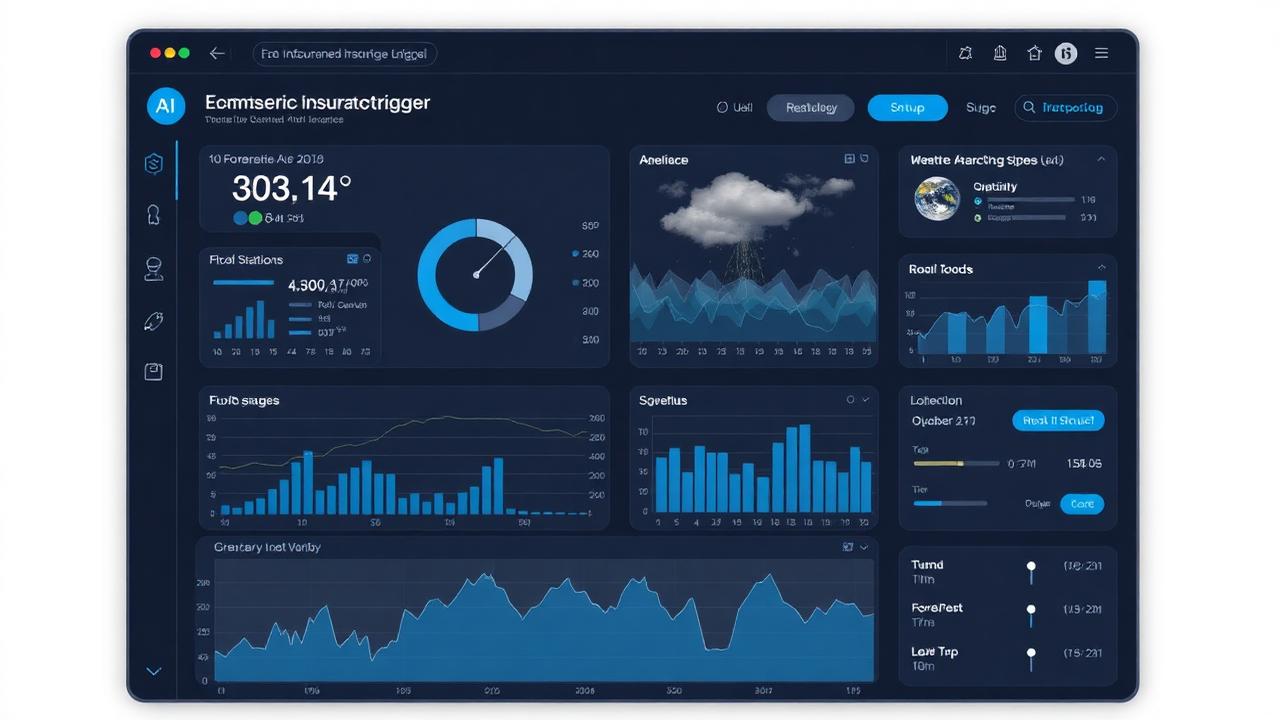
The trending use cases driving the 2026 parametric insurance boom
Not every line of business is a fit. Parametric cover thrives where losses are correlated with measurable physical events and where speed of payout matters more than perfect loss matching. In 2026, the breakout use cases share that DNA.
1. Climate and catastrophe cover for SMEs and homeowners
Small businesses and homeowners are the most underserved segment in catastrophe insurance. Manual underwriting is too expensive, and traditional indemnity claims are too slow to keep them afloat after a flood or storm. AI-priced parametric products — windstorm, flood depth, wildfire perimeter — are filling the gap with affordable, fast-paying micro-policies sold through banks, utility apps and embedded checkout flows.
2. Agriculture and food security
Drought, excess rainfall and frost cover are now the largest single use case for parametric insurance globally. AI models combine satellite NDVI imagery, soil moisture data and local weather to price weather-index policies that pay farmers within days of a bad season. In emerging markets, mobile-first parametric crop cover is becoming a key tool of financial inclusion, backed by development banks and donor capital.

3. Travel, delay and event cancellation
Flight-delay cover that pays automatically when your inbound flight is more than two hours late. Event-cancellation cover for festivals priced against historical weather and attendance data. Cruise and adventure-travel cover triggered by named-storm tracks. Embedded into booking flows, these products feel less like insurance and more like a built-in guarantee — which is exactly why they are converting at rates traditional travel cover never managed.
4. Cyber and business-interruption parametrics
An emerging frontier. Parametric cyber pays a fixed amount when measurable cyber events occur — for example, a confirmed cloud outage above a duration threshold, or a regional ransomware spike. It complements traditional cyber coverage and gives finance teams cash quickly, before the full loss is even quantified.
Inside the AI parametric insurance tech stack
Carriers and MGAs leading the 2026 wave are converging on a recognizable architecture. The vendor names vary, but the layers are consistent.
- Data layer: satellite providers, national weather services, IoT sensor networks, seismic feeds and on-chain oracles unified in a geospatial data lake.
- Modelling layer: AI catastrophe models, machine-learning trigger calibration and basis-risk simulators run continuously against historical loss data.
- Orchestration layer: trigger monitors, sanctions and fraud checks, and a payout engine wired into instant-payment rails.
- Distribution layer: embedded APIs for banks, e-commerce, travel and energy platforms — most parametric policies in 2026 are sold inside another product.
- Governance layer: model cards, fairness reviews, audit trails and consumer disclosures aligned with the EU AI Act and NAIC Model Bulletin.
The carriers winning here are not the ones with the flashiest model. They are the ones with the cleanest data pipelines and the strongest governance, which together let them launch new parametric products in weeks rather than years.
How AI shrinks basis risk — the make-or-break problem
Basis risk is the silent killer of parametric insurance. If a hurricane causes major losses but the wind-speed sensor at the reference station falls just below the trigger, customers feel cheated and the product loses trust. AI helps in three concrete ways.
First, multi-source triggers. Instead of relying on one weather station, AI fuses dozens of data sources — satellite, radar, ground sensors, social-media signal — into a composite index that tracks real damage far more closely. Second, hyper-local resolution. Modern geospatial AI can price risk at the postcode or even the building level, so payouts match what actually happened in that specific spot. Third, continuous recalibration. Models retrain after every major event, learning where triggers under- or over-shoot reality and tightening the design for the next one.
Regulation, ethics and the parametric insurance trust gap

Because parametric insurance pays a fixed amount regardless of actual loss, regulators have historically been cautious. They worried about consumer understanding, the line between insurance and derivatives, and the risk of unfair outcomes when triggers miss real damage. In 2026, the regulatory picture is finally clearing up. The EU AI Act classifies many parametric underwriting models as high-risk, requiring documentation, monitoring and human-oversight controls. The NAIC Model Bulletin on AI is being adopted across US states, demanding governance frameworks and bias testing. UK and APAC regulators are aligning to similar expectations.
The carriers and MGAs that invested early in AI governance are now reaping the reward — faster product approvals, better reinsurance terms, and a credibility advantage when selling to corporate and government buyers. Governance is no longer a tax. It is a moat.
Where AI parametric insurance pays back fastest
Not all parametric programs are equal. The highest-ROI plays in 2026 cluster in three areas.
Embedded distribution
Plugging parametric cover into bank apps, airlines, energy retailers and agricultural cooperatives drives attachment rates that direct sales cannot touch. The combined cost of acquisition is a fraction of traditional insurance, and AI handles eligibility and pricing in milliseconds.
Government and donor-funded programs
Sovereign and city-level parametric programs — protecting public budgets against hurricanes, earthquakes or pandemics — are a fast-growing pool of premium. AI helps design, price and monitor these programs transparently, which is exactly what public funders demand.
Renewals and dynamic repricing
Continuous AI scoring lets carriers reprice parametric portfolios as climate data shifts, instead of waiting for losses to break the book. The result is a more resilient portfolio and a more honest conversation with policyholders.
A 90-day rollout plan for carriers and MGAs
Days 1–30: pick the wedge
Choose one product, one geography and one distribution partner. Build the data pipeline, define the trigger, and run the AI model in shadow mode against historical events. Stand up an AI governance committee with actuarial, legal, claims and distribution at the table.
Days 31–60: assisted launch
Soft-launch with a single embedded partner. Use AI to monitor trigger performance, basis-risk gaps and customer complaints daily. Publish a plain-language explainer and model card for the product.
Days 61–90: scale and govern
Onboard a second distribution partner, automate payouts end-to-end and feed event learnings back into the model. By day 90 you should have a working product, clean financials, and a governance pack reinsurers and regulators will respect.
How parametric insurance fits the wider 2026 InsurTech picture
Parametric is not an island. It sits inside a broader shift toward AI-native insurance — embedded distribution, agentic claims and continuous underwriting — that is rewiring the industry from underwriting to payout. For deeper context, see our companion guides on AI cyber insurance in 2026, agentic AI in insurance claims, embedded insurance and AI, and the future of AI in insurance. Together they map the same trend from different angles: insurance becoming software, and software becoming insurance.
Conclusion: the decade of instant insurance has begun
Parametric insurance and AI did not become a trend in 2026 by accident. Climate volatility made the old model unsustainable. Satellites, sensors and AI finally made a new one possible. Regulators created enough clarity to scale it responsibly. The next five years will see parametric cover expand far beyond catastrophe — into supply chains, energy markets, healthcare wait times, even AI model outages. The winners will be the carriers, MGAs and platforms that treat parametric not as a product line, but as a new operating system for risk. The losers will be the ones who keep mailing out claim forms while their customers wait for a payout that should have arrived two hours after the storm passed. Build now, govern well, and let the data — not the paperwork — decide.
Sources
- Swiss Re Institute — sigma research on parametric and natural catastrophe insurance
- Munich Re — Climate change and parametric solutions insights
- NAIC — Model Bulletin on the Use of Artificial Intelligence Systems by Insurers
- EU AI Act — Official consolidated text
Key takeaways
- Parametric insurance and AI are the breakout InsurTech combo of 2026, driven by climate volatility and cheaper geospatial data.
- AI dissolves the two historical weaknesses of parametric cover: basis risk and slow product design.
- The hottest use cases are climate cover for SMEs and homeowners, agriculture, travel and parametric cyber.
- Governance — model cards, audit trails, EU AI Act and NAIC alignment — is the real competitive moat.
- Start with one product, one geography and one distribution partner, and scale in 90-day cycles.
Continue learning on InsurAI Buzz
- AI Voice Agents in Insurance 2026: How Conversational AI Is Rebuilding the Contact Center — Insurance Chatbots
- Small Language Models in Insurance 2026: Why Carriers Are Moving Beyond Frontier LLMs — AI Tools & Software
- AI Copilots for Insurance Agents in 2026: How Generative AI Is Rebuilding the Front Office — AI Automation
Authoritative sources & further reading
Frequently asked questions
What is parametric insurance and how does AI improve it?
Parametric insurance pays a pre-agreed amount when a measurable trigger — like wind speed, rainfall or earthquake magnitude — crosses a threshold. AI improves it by designing better triggers, fusing satellite and IoT data to shrink basis risk, monitoring events in real time and automating payouts within hours of an event.
Why is parametric insurance growing so fast in 2026?
Climate volatility, cheaper satellite and IoT data and mature AI models have combined to make parametric cover both necessary and finally practical at scale. Swiss Re and Howden expect the market to roughly double between 2024 and 2027, driven by climate, agriculture, travel and embedded distribution.
How does AI reduce basis risk in parametric insurance?
AI fuses multiple data sources — satellite imagery, ground sensors, radar and even social-media signal — into composite, hyper-local triggers that track actual losses more closely. Models retrain after every major event, tightening the relationship between trigger and damage on the ground.
Is AI parametric insurance compliant with the EU AI Act and NAIC rules?
It can be, with proper governance. Most parametric underwriting models are classified as high-risk under the EU AI Act, requiring documentation, monitoring and human oversight. The NAIC Model Bulletin demands similar governance frameworks across US states. Carriers that invest in model cards, audit trails and fairness testing meet both regimes and unlock better reinsurance terms.
Stay ahead of AI in insurance
Subscribe for weekly analysis trusted by underwriters, claims leaders and insurtech founders.
Subscribe freeRelated reading

AI Cyber Insurance in 2026: How Carriers Are Pricing the Ransomware Era
AI is rewriting the cyber insurance playbook in 2026 — from real-time risk scoring and machine-speed underwriting to agentic ransomware response. Here is the complete guide carriers, brokers and risk managers actually need.

Embedded Insurance & AI in 2026: The $700B Trend Quietly Eating the Industry
Embedded insurance is the breakout story of 2026 — and AI is the engine making it work. Here is the complete playbook on the $700B opportunity reshaping how policies are priced, sold, and serviced.

Agentic AI in Insurance: How Autonomous Agents Are Rewriting Underwriting, Claims & Service in 2026
Agentic AI has moved from buzzword to balance sheet. Here is how autonomous AI agents are reshaping insurance in 2026 — and what carriers must do this quarter to keep up.