
AI Voice Agents in Insurance 2026: How Conversational AI Is Rebuilding the Contact Center
Text chatbots got insurance comfortable with conversational AI. In 2026, voice is where the real disruption is happening. Here is the complete guide to AI voice agents in insurance — how they work, where they are winning, what they cost, and how to deploy them without breaking compliance.

For most of the last decade, conversational AI in insurance meant a text chatbot bolted onto a website that could answer five questions and route everything else to a human. In 2026, that picture has changed completely. The breakout technology in insurance customer experience this year is the AI voice agent — a generative, real-time, human-sounding system that can take a first notice of loss call at 2 a.m., service a policy change in plain English, quote a homeowners renewal, and escalate cleanly when it should. Voice is where conversational AI in insurance is finally living up to a decade of hype, and the carriers moving fastest are quietly rewriting the economics of the contact center. This is the complete 2026 guide to AI voice agents in insurance: what they are, why they are exploding now, where they create the most value, and how to deploy them without inviting a regulatory storm.
What an AI voice agent actually is
An AI voice agent is a real-time conversational system that listens to a caller, understands intent, retrieves information from core systems, reasons over it, and responds in natural speech — all in under a second of round-trip latency. Modern voice agents combine three layers: a streaming speech-to-text model, a generative language model (often a small or mid-sized one), and a streaming text-to-speech model that produces voices indistinguishable from a trained human agent. Wrapping that stack are guardrails, retrieval pipelines and integrations into the carrier's policy admin, claims and CRM systems.
What makes 2026 different from previous voice IVR generations is the disappearance of the rigid script. Old IVRs forced callers to navigate menus and say magic words. Today's AI voice agents handle interruptions, understand accents, manage hold times, and recover gracefully from confusion. For policyholders, the experience finally feels like talking to a competent person rather than fighting a robot.
Voice agents vs text chatbots: why voice is winning in insurance
- Insurance is still a phone-first industry — over 60% of claims and service interactions begin with a call.
- Voice handles emotional, urgent moments (accidents, storm losses, bereavement) where typing is the wrong channel.
- A voice agent can fully resolve a call; a text bot usually deflects or summarises before handing off.
- Voice creates a perfect, timestamped audio record — a compliance dream.
- Modern TTS quality removes the robotic stigma that capped previous voice automation.

Why 2026 is the breakout year for voice AI in insurance
Three forces are converging this year to push voice AI from pilot to production across personal lines, commercial lines and life and health. The first is model quality. Streaming speech-to-text now hits human-parity word error rates on noisy phone audio. Streaming TTS sounds genuinely human, with natural pauses and prosody. And small language models — covered in our companion guide on small language models in insurance — make sub-second response latency economically viable at scale.
The second force is the contact-center economics carriers can no longer ignore. Talent shortages, rising wages and shrinking call-center real estate have made every minute of human handle time expensive. McKinsey's research on insurance operations shows that customer service and claims intake together account for a disproportionate share of carrier opex. Voice AI attacks that line directly.
The third force is regulatory clarity. The NAIC Model Bulletin on AI, the EU AI Act and a growing patchwork of US state guidance now give carriers a clear framework for deploying conversational AI responsibly — including disclosure, audit logging and human-in-the-loop requirements. Carriers that were waiting for the rules now have them.
Where AI voice agents are winning in insurance today
Voice AI is not a single use case. It is a new operating layer across the customer journey. The highest-ROI deployments in 2026 cluster around five workflows.
1. First notice of loss (FNOL) intake
FNOL is the perfect first use case for voice AI. Volume is high, calls are emotional but structured, and the data captured is well-defined. A voice agent can answer instantly at any hour, ask the right questions, capture loss details, validate coverage, schedule an inspection and trigger downstream workflows — all without a human touch on simple claims. For carriers running this in production, average handle time on simple auto and property claims has fallen by 30 to 50 percent, and after-hours abandonment has effectively gone to zero.
2. Policy servicing and endorsements
Address changes, vehicle additions, beneficiary updates, certificate of insurance requests — these are the unglamorous, high-volume calls that drown service teams. AI voice agents handle them end to end, reading and writing directly into policy admin systems with audit trails the compliance team actually likes.
3. Sales, quoting and renewals
Outbound renewal calls and inbound quote requests are increasingly handled by voice agents that can run a real conversation, gather rating information, present options and warm-transfer to a licensed human agent only when regulation requires it. The same orchestration patterns we explored in our piece on AI copilots for insurance agents in 2026 now extend into the voice channel.
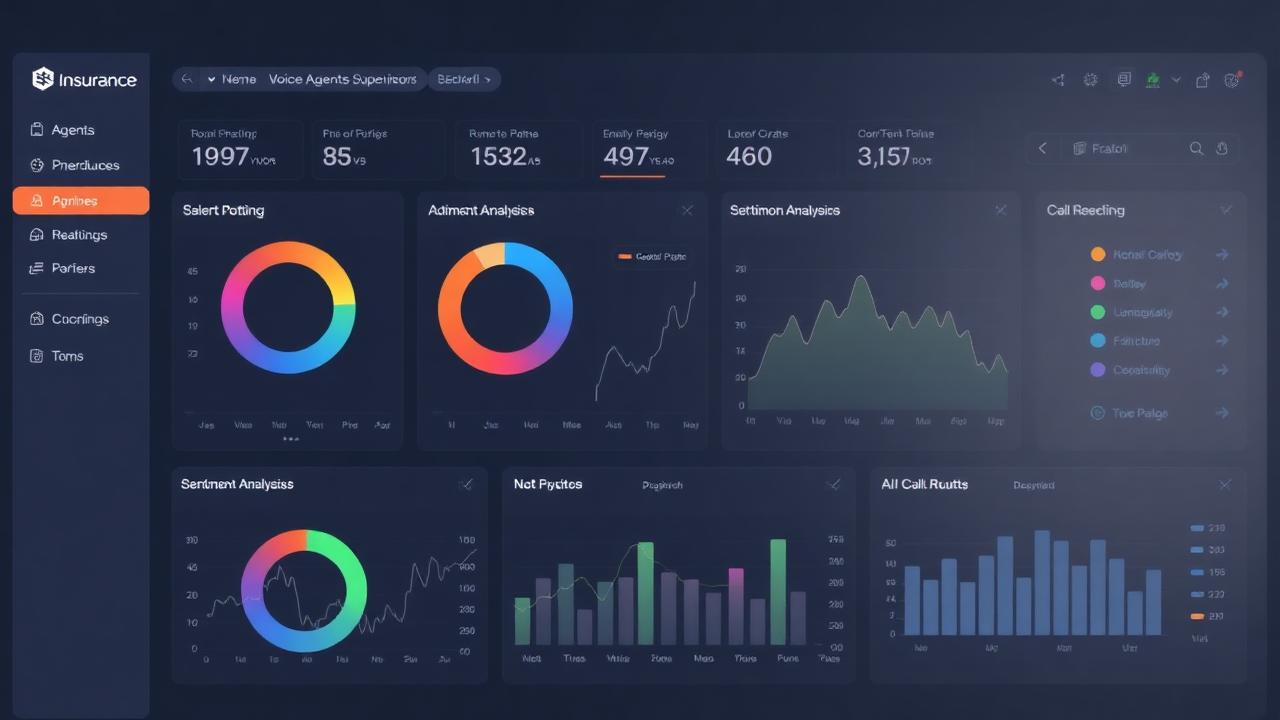
4. Collections, payments and retention
Voice agents are also moving into the moments-of-truth that drive retention: failed payments, lapse warnings, win-back outreach. Done well, an empathetic voice agent that reaches a customer the day a payment fails saves more policies than a letter sent ten days later — and at a fraction of the cost of a human dialer team.
5. Agent and adjuster assist
Beyond fully automating calls, voice AI is increasingly listening on human calls in real time, surfacing relevant policy details, suggesting the next best action and drafting wrap-up notes. This blended model — autonomous on routine, assistive on complex — is becoming the default contact-center architecture.
Inside the architecture: how a 2026 voice agent is built
Under the hood, a production-grade insurance voice agent is a tightly integrated stack rather than a single product. The components matter because they decide latency, cost and compliance posture.
- Telephony layer — SIP trunking and a real-time media server that streams audio bidirectionally with sub-200ms jitter.
- Streaming ASR — speech-to-text optimised for phone-quality audio, multiple accents and insurance vocabulary.
- Reasoning core — a small or mid-sized language model fine-tuned on the carrier's products, scripts and tone, often paired with retrieval over policy and claims data.
- Tool use — typed function calls into policy admin, claims, billing, document and identity systems.
- Streaming TTS — a natural-sounding voice with consistent brand persona, supporting interruption and barge-in.
- Guardrails — content filters, PII redaction, scope limits and explicit handoff triggers.
- Observability — full call recording, transcripts, structured event logs and quality scoring on every conversation.
The deepest architectural shift in 2026 is the move toward agentic voice — voice agents that can chain multiple steps, call several systems and reason across a longer task without losing the conversational thread. This sits naturally alongside the workflow patterns we covered in our analysis of agentic AI in insurance claims.
The economics: what voice AI actually costs and saves
Voice AI economics are no longer experimental. In 2026, well-deployed agents cost in the range of a few cents to a dollar per call depending on length and complexity, compared to several dollars for a fully loaded human-handled call. More importantly, they unlock capacity carriers cannot otherwise hire — 24/7 coverage, surge handling during catastrophe events, and consistent service in languages that are uneconomic to staff.
- Cost per call typically 60–85% lower than human-only handling on automatable intents.
- Average speed of answer collapses from minutes to seconds, even during CAT events.
- Containment rates of 50–70% on policy service and 30–50% on FNOL are realistic in year one.
- CSAT often rises after deployment because wait times and inconsistency drop.
- Human agents shift to higher-value, higher-empathy work, reducing attrition.
Governance, compliance and consumer trust
Voice AI sits at the intersection of insurance regulation, consumer protection law and emerging AI rules. Carriers cannot treat it as a pure IT project. The NAIC's Model Bulletin on the use of AI by insurers, the EU AI Act's transparency obligations and a growing list of state-level disclosure requirements all touch voice deployments.
The 2026 governance checklist for insurance voice agents
- Disclose to callers, up front, that they are speaking with an AI agent.
- Capture explicit consent for recording and AI processing where required.
- Restrict the agent's scope to actions the carrier has approved and tested.
- Keep a human-in-the-loop pathway for any decision affecting coverage, pricing or claims outcomes.
- Log full audio, transcripts, prompts, retrieved data and tool calls in immutable storage.
- Run pre-deployment bias and accessibility testing across accents, dialects and ages.
- Monitor sentiment, hallucination and resolution metrics in production with alerting.
- Align disclosures and data handling with the EU AI Act and state-level rules.
The risks carriers must manage
Voice AI is powerful, but the failure modes are real. The biggest risks in 2026 are not technological — they are operational. Hallucinated coverage statements, mis-routed escalations, accents the model handles poorly, and over-automation of emotional calls all damage trust quickly. Deepfake voice fraud is also rising on the inbound side, which is why voice biometrics and challenge questions are becoming standard at authentication.
- Never let the agent commit coverage or settlement without an approved policy.
- Build explicit empathy detection and handoff triggers for distressed callers.
- Use voice biometrics plus knowledge factors to defend against deepfake impersonation.
- Continuously sample calls for QA — automation does not remove supervisory duty.
- Re-test after every model or prompt change as you would after any rate change.
How to launch a voice AI program: a 90-day playbook
The carriers winning with voice AI in 2026 share a disciplined launch pattern. The pattern below is the one that consistently survives the move from pilot to scale.
- Days 1–15: Pick one narrow intent (e.g. auto FNOL or address change) with high call volume and clean data.
- Days 16–30: Stand up the voice stack in a sandbox; integrate to the relevant policy or claims system; design disclosure and handoff flows with compliance.
- Days 31–60: Run a shadow pilot on a small caller cohort; measure containment, CSAT, edit rates, escalation quality.
- Days 61–90: Expand to full traffic on the chosen intent; add monitoring, QA sampling and supervisor tooling.
- Day 90+: Add adjacent intents one at a time, locking in governance, observability and human-handoff patterns at every step.
What comes next: the voice-first insurance experience
By 2027, the leading carriers will not run voice AI as a contact-center feature. They will run the contact center as a voice AI platform, with humans layered in for the moments that demand them. Combined with embedded distribution, parametric payouts and agentic claims, voice becomes the connective tissue of a fundamentally faster insurance experience. We track the broader arc of that shift in our outlook on the future of insurance AI.
The bottom line for insurance leaders in 2026
AI voice agents are no longer a science project. They are a deployable layer of the insurance operating model with proven economics, real regulatory guardrails and measurable customer benefit. The carriers, MGAs and InsurTechs that win the next phase will not be the ones with the loudest voice AI launch. They will be the ones who pick the right intents, govern the rollout with discipline, and use the freed-up human capacity to deliver the empathy that automation cannot. Voice is how conversational AI in insurance finally grows up.
Related reading on InsurAI Buzz
If you found this guide useful, you may also want to read our deep dive on small language models in insurance, our analysis of AI copilots for insurance agents in 2026, our guide to agentic AI in insurance claims, and our outlook on the future of insurance AI.
Sources and further reading
Key takeaways
- AI voice agents are the breakout 2026 trend in insurance contact centers.
- Voice handles the emotional, phone-first moments where insurance still happens.
- Per-call costs fall 60–85% on automatable intents, with CSAT typically rising.
- Disclosure, consent, scope limits and human handoff are non-negotiable in 2026.
- Carriers without a voice AI roadmap will lose the customer experience race into 2027.
Continue learning on InsurAI Buzz
- Small Language Models in Insurance 2026: Why Carriers Are Moving Beyond Frontier LLMs — AI Tools & Software
- AI Copilots for Insurance Agents in 2026: How Generative AI Is Rebuilding the Front Office — AI Automation
- Parametric Insurance and AI in 2026: How Instant Payouts Are Reshaping Climate and Catastrophe Coverage — Future of Insurance AI
Frequently asked questions
What is an AI voice agent in insurance?
An AI voice agent in insurance is a real-time conversational AI system that handles policyholder phone calls end to end — including FNOL intake, policy servicing, quoting and renewals — using streaming speech-to-text, a generative language model and natural text-to-speech, all integrated into the carrier's core systems with compliance guardrails.
Why are insurers adopting voice AI so fast in 2026?
Three forces converged: streaming speech and TTS finally reached human-quality, small language models made sub-second response economical at scale, and the NAIC Model Bulletin plus the EU AI Act gave carriers a clear governance framework. Combined with contact-center cost pressure, voice AI moved from pilot to production.
Where do AI voice agents create the most value in insurance?
The highest-ROI use cases in 2026 are first notice of loss intake, policy service and endorsements, quoting and renewals, payments and retention outreach, and real-time agent assist. These workflows are high-volume, structured and sensitive to speed and after-hours availability.
How should an insurer launch a voice AI program safely?
Start with one narrow, high-volume intent like auto FNOL or address change. Build the voice stack with explicit disclosure, consent, scope limits and human handoff. Shadow pilot on a small cohort, measure containment, CSAT and escalation quality, then expand intent by intent with full audio and event logging for compliance.
Stay ahead of AI in insurance
Subscribe for weekly analysis trusted by underwriters, claims leaders and insurtech founders.
Subscribe freeRelated reading

Insurance Chatbots: How Conversational AI Is Quietly Replacing the Call Center
From quote-to-bind to mid-term policy changes, modern insurance chatbots resolve more than 70% of customer interactions without a human.